


## Short Answer
**Swing over carriage** is the maximum diameter of a workpiece that can rotate above the lathe carriage without touching it. It is usually smaller than **swing over bed** because the carriage sits higher than the bed.
For calculation, it is twice the vertical distance from the spindle centerline to the highest point of the carriage. Therefore:
Swing over carriage = 2 × (Distance from spindle centerline to top of carriage)

For example, if a lathe has a **610 mm swing over carriage**, a workpiece smaller than Ø610 mm may physically rotate above the carriage. However, this does not mean the machine can actually turn a Ø610 mm part. The real turning capacity also depends on the cross slide, tool post, chuck, tool position, and required safety clearance.
For buyers machining **large shafts, flanges, rollers, sleeves, and pipe components**, swing over carriage is an important specification to check before selecting a lathe.
## Why It Matters
A workpiece may fit over the bed but still interfere with the carriage.
This is especially important when machining:
* 316 stainless steel sleeves
* 42CrMo stepped shafts
* Large steel flanges
* Oilfield pipe couplings
* Industrial rollers
If your workpiece has a large shoulder or flange that extends above the carriage, **swing over carriage may become the actual size limitation**.
## Difference: Swing Over Bed vs. Swing Over Carriage
| Parameter | What It Tells You |
| —————————- | ————————————————— |
| **Swing Over Bed** | Maximum diameter that can rotate above the bed |
| **Swing Over Carriage** | Maximum diameter that can rotate above the carriage |
| **Maximum Turning Diameter** | Maximum diameter the machine can practically cut |

Normally:
**Swing over bed > Swing over carriage**
So, **can a 600 mm diameter workpiece fit on a lathe with 800 mm swing over bed?** Not necessarily. You also need to check the swing over carriage and actual turning diameter.
## Example
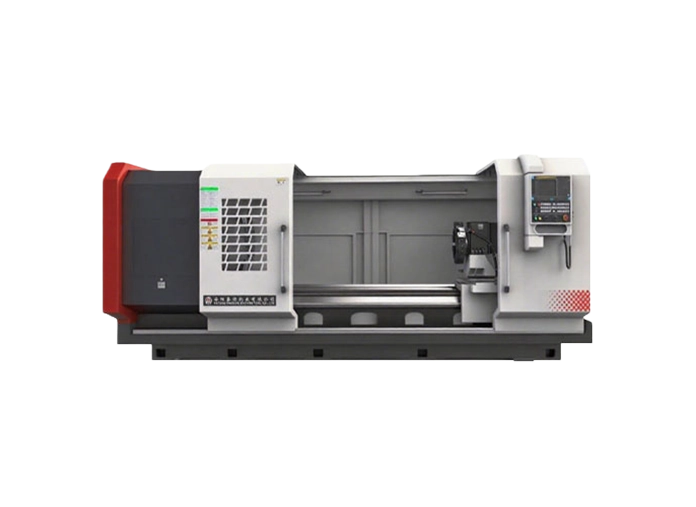
Take a **Q1227 Conventional Pipe Threading Lathe** as an example:
* Swing over bed: **Ø1000 mm**
* Swing over carriage: **Ø610 mm**
* Spindle bore: **Ø280 mm**
* Pipe threading range: **Ø130–270 mm**
* Maximum workpiece weight: **6,000 kg**
Suppose the workpiece is a **42CrMo steel shaft** with a Ø520 mm shoulder and a Ø240 mm main body.
Because Ø520 mm is smaller than the machine’s Ø610 mm swing over carriage, it has nominal rotational clearance. However, the chuck, tool post, cutting position, and workpiece weight must still be checked before machining.
## Common Mistakes
**Mistake 1: Swing over bed equals maximum turning diameter.**
It does not. Swing mainly describes physical clearance.
**Mistake 2: Ignoring the largest section of a stepped shaft.**
A Ø250 mm shaft with a Ø600 mm flange must be evaluated based on the Ø600 mm section.
**Mistake 3: Confusing spindle bore with swing over carriage.**
Spindle bore determines what size bar or pipe can **pass through the spindle**; swing over carriage determines what diameter can **rotate above the carriage**.
## Buyer Checklist
Before choosing a lathe, check:
* Maximum and minimum workpiece diameter
* Position of the largest diameter
* Swing over bed
* Swing over carriage
* Maximum turning diameter
* Workpiece length and weight
* Spindle bore
* Chuck capacity
* Tool and cross-slide clearance
For stepped shafts, flanges, and other large components, always send the **workpiece drawing** to the machine manufacturer.
## FAQ
### What swing over carriage do I need for a 500 mm diameter shaft?
If the Ø500 mm section must rotate above the carriage, choose a machine with a **swing over carriage greater than 500 mm** and confirm its actual turning capacity.
### Can a lathe with 610 mm swing over carriage machine a 600 mm part?
Not necessarily. Ø610 mm indicates nominal clearance. Tool post, cross slide, cutting tool, workpiece runout, and safety clearance may reduce usable capacity.
### Why is swing over carriage smaller than swing over bed?
Because the carriage sits higher than the bed, leaving less vertical clearance between the carriage and spindle centerline.
### Is swing over carriage important for pipe threading lathes?
Yes. It is especially important for **large pipe couplings, flanges, tool joints, and stepped oilfield components**. For long pipes passing through the spindle, you should also check the **spindle bore and pipe threading range**.
### What information should I send when asking for a lathe quotation?
Provide the **workpiece diameter, length, weight, material, drawing, tolerance, and machining process**. For example:
**42CrMo steel shaft | Max. OD Ø520 mm | Main OD Ø240 mm | Length 2000 mm | OD turning + facing + shoulder turning**
This gives the manufacturer enough information to check swing over carriage, turning capacity, chuck size, and workpiece support.