

The chuck and spindle nose form the main connection between the lathe spindle and the workpiece. Choosing them correctly affects workpiece clamping, spindle compatibility, available through-hole capacity, cutting stability, and production efficiency.
A common mistake is to choose a lathe simply by chuck diameter. In practice, buyers should evaluate the workpiece, chuck type, spindle nose, spindle bore, and clamping method together.
Selection Steps
Step 1: Start with the Workpiece
Before selecting a chuck, confirm:
For example, a Φ100 mm solid shaft and a Φ100 mm pipe may have the same outside diameter but require different spindle and chuck configurations.
For bar or pipe machining, the spindle bore and chuck through-hole become especially important because the material may need to pass through the spindle.
Step 2: Choose the Chuck Type
The most common options are 3-jaw and 4-jaw chucks.
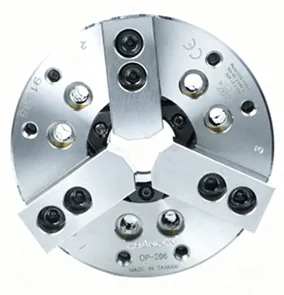
A 3-jaw chuck is convenient for round and regularly shaped workpieces because the jaws move together. It is widely used for general shaft and bar turning.
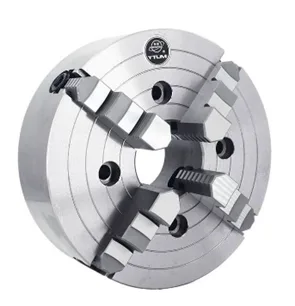
A 4-jaw independent chuck allows each jaw to be adjusted separately. It is useful for large, irregular, square, cast, or forged workpieces and applications requiring individual centering adjustment.
The actuation method also matters:
Manual chuck – practical for repair work, single parts, and small batches.
Hydraulic chuck – suitable for repeated production where faster and more consistent clamping is required.
Pneumatic chuck – another option for automated clamping, particularly in suitable pipe-processing applications.
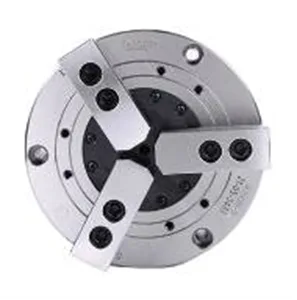
Xinheng’s machine-selection guidance similarly recommends manual chucks for flexible low-volume work and hydraulic chucks for repeated production.
Step 3: Check the Spindle Nose
The spindle nose is the mounting interface at the front of the spindle. The chuck or chuck adapter must be compatible with this interface.
Common CNC lathe spindle noses include:
A2-5 → A2-6 → A2-8 → A2-11 → A2-15
As machine and spindle size increase, larger spindle-nose specifications are generally used.
For example, Xinheng’s AE-series illustrates this relationship:
| Model | Spindle Nose | Spindle Bore | Chuck |
| AE40B | A2-6 | Φ66 mm | 8 inch |
| AE45B | A2-6 | Φ66 mm | 10 inch |
| AE50B | A2-8 | Φ86 mm | 12 inch |
These are actual machine configurations rather than a universal rule linking a particular spindle nose to only one chuck size.
Step 4: Check Spindle Bore and Chuck Through-Hole
Do not confuse spindle nose, spindle bore, and chuck size.
Spindle nose = how the chuck connects to the spindle
Spindle bore = diameter of the hole through the spindle
Chuck size = nominal diameter of the chuck
Chuck through-hole = opening through the chuck for bar or pipe
For through-spindle machining, the usable material diameter is limited by the relevant passage dimensions, not by chuck diameter alone.
For example, Xinheng’s AD-series lists an AD15B with an A2-6 spindle nose, Φ62 mm spindle bore, Φ52 mm hollow-chuck bore, and 8-inch chuck. The larger AD45 uses A2-11, Φ131 mm spindle bore, Φ120 mm hollow-chuck bore, and a 15-inch chuck.
Step 5: Consider Cutting Load
Large workpieces and heavy roughing require more than simply larger jaws.
The spindle, chuck, spindle nose, machine bed, motor, and workpiece support must be suitable for the cutting load.
Xinheng’s 970 mm guideway CNC lathe series, for example, uses an A2-15 spindle nose with a Φ130 mm spindle bore on machines designed for workpieces up to 10 tons.
This shows why spindle-nose selection is normally part of the complete machine design rather than an isolated parameter.
Recommended Configuration
For small and medium round bars and shafts, a 3-jaw hydraulic chuck is practical when repeated production and quick clamping are priorities.
For large shafts, forgings, castings, and irregular workpieces, a 4-jaw chuck may provide greater adjustment flexibility.
For bar production, check the hydraulic hollow chuck, chuck through-hole, spindle bore, and allowable bar diameter together.
For long pipes, a conventional single front chuck may not be sufficient. A pipe-threading lathe with a large hollow spindle and suitable front/rear clamping arrangement should be considered.
For repair and low-volume production, a manual chuck can remain a practical choice because of its simple and flexible operation.
Buyer Checklist
Before ordering a lathe, confirm:
Xinheng also recommends starting with workpiece diameter, length, and weight, then checking spindle bore, chuck, tailstock, and other configuration requirements.
FAQ
Is a larger chuck always better?
No. The chuck should match the workpiece, spindle, machine structure, and required speed. An unnecessarily large chuck adds rotating mass and may not provide any benefit for small components.
Is an A2-8 spindle nose the same as an 8-inch chuck?
No. A2-8 is a spindle mounting-interface designation. Chuck diameter is a separate specification.
Should I choose a 3-jaw or 4-jaw chuck?
For regular round parts and repeated production, a 3-jaw chuck is often convenient. For irregular workpieces or applications requiring independent jaw adjustment, a 4-jaw chuck may be more suitable.
When should I choose a hydraulic chuck?
A hydraulic chuck is useful for repeated production where faster clamping and reduced manual operation are important. Xinheng’s AE-series, for example, uses hydraulic hollow chucks in 8-, 10-, and 12-inch configurations depending on model.
What is most important for bar or pipe machining?
Check the complete material passage: chuck through-hole + spindle bore + allowable bar/pipe diameter. The smallest relevant passage dimension can limit the material that can pass through.
What information should I send to the manufacturer?
Send the workpiece drawing, OD, ID, length, weight, material, machining operations, production quantity, and clamping requirements. If the workpiece must pass through the spindle, clearly specify the maximum bar or pipe OD.
For different spindle, chuck, and CNC lathe configurations, see Anyang Xinheng Machine Tool.