


## Short Answer
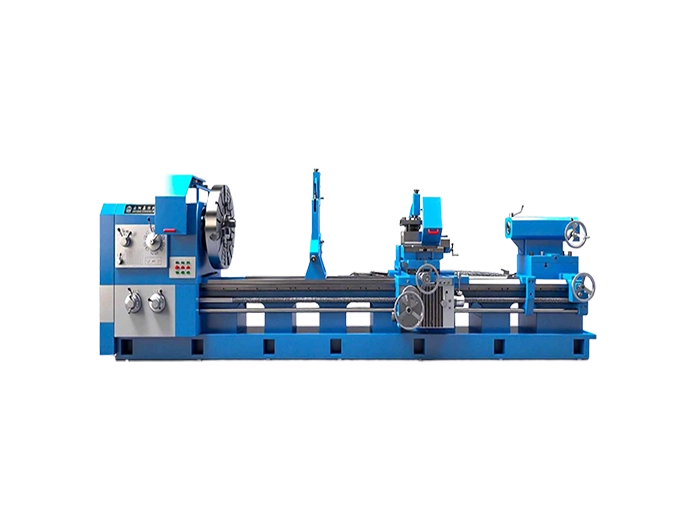
A **conventional lathe machine** is a manually operated machine tool used to turn cylindrical metal workpieces such as shafts, sleeves, flanges, rollers and pipes. The workpiece rotates in the spindle while the operator controls the cutting tool to perform turning, facing, boring, grooving and threading.
Unlike a CNC lathe, a conventional lathe does not rely on a CNC program for normal machining operations. The operator controls spindle speed, feed, cutting depth and tool movement directly.
Conventional lathes are widely used in **machine shops, maintenance workshops, repair facilities, training centers and small-batch manufacturing** because they are flexible, easy to set up and economical for one-off or low-volume jobs. Machine size can range from compact workshop lathes to heavy-duty models for large shafts and industrial components.

—
# 1. Applications
Conventional lathes are especially useful when production volume is relatively low or when workpieces frequently change in size and shape.
## Typical Industries and Workpieces
| Industry | Typical Workpiece | Material Example | Typical Process |
|—|—|—|—|
| General machinery | Stepped shaft | 45# Steel | OD turning + facing + threading |
| Maintenance workshop | Repair shaft | 40Cr | Turning + thread repair |
| Hydraulic equipment | Sleeve | 45# Steel | OD turning + ID boring |
| Valve industry | Flange | 316 Stainless Steel | Facing + OD turning + boring |
| Energy equipment | Large shaft | 42CrMo | Rough + finish turning |
| Steel industry | Roller | Forged steel | Heavy OD turning |
| Pipeline repair | Pipe / coupling | Carbon steel | Turning + threading |
### Example 1: 40Cr Repair Shaft
Consider a maintenance workshop repairing this workpiece:
| Item | Data |
|—|—:|
| Workpiece | Stepped transmission shaft |
| Material | 40Cr |
| Maximum diameter | Ø180 mm |
| Length | 1200 mm |
| Process | Facing + OD turning + grooving + thread repair |
| Quantity | 2 pcs |
| Workholding | 3-jaw chuck + tailstock |
For only two replacement shafts, programming and setting up a CNC production process may not be necessary.
A conventional lathe allows the operator to measure the worn shaft, adjust the machining allowance and perform repair operations directly.
This is why conventional lathes remain common in **maintenance and repair workshops**.
—
## When Should I Use a Conventional Lathe Instead of a CNC Lathe?
The answer mainly depends on production quantity and part complexity.
| Requirement | Conventional Lathe | CNC Lathe |
|—|—|—|
| One-off part | Excellent | Possible |
| Repair work | Excellent | Possible |
| Small batch | Good | Good |
| Large batch | Limited | Excellent |
| Frequent workpiece changes | Good | Good |
| Complex contour | Limited | Excellent |
| Automatic production | No | Yes |
| Operator skill requirement | High | Programming + operation |
| Initial investment | Generally lower | Generally higher |
For buyers asking:
**“Is a conventional lathe better than a CNC lathe for repair work?”**
A conventional lathe is often the more practical choice for **one-off repairs, prototype parts and frequently changing workpieces**.
—
# 3. Key Parameters
Understanding lathe specifications is more important than simply comparing model numbers.
## Main Conventional Lathe Parameters
| Parameter | What It Means | Why It Matters |
|—|—|—|
| Swing over bed | Maximum diameter rotating above bed | Basic workpiece diameter capacity |
| Swing over carriage | Maximum diameter rotating above carriage | Limits machining clearance |
| Swing over gap | Maximum diameter rotating in gap area | Important for short, large-diameter parts |
| Distance between centers | Available length between headstock and tailstock | Important for shafts |
| Max. workpiece length | Maximum supported workpiece length | Determines machine size |
| Spindle bore | Through-hole diameter of spindle | Important for bars and pipes |
| Spindle speed | Available spindle RPM range | Affects cutting conditions |
| Chuck size | Chuck diameter and clamping capacity | Determines workholding |
| Guideway width | Width of bed guideways | Related to rigidity |
| Main motor power | Spindle driving power | Important for heavy cutting |
| Max. workpiece weight | Maximum supported load | Critical for heavy parts |

—
—
# 4. Configuration
A conventional lathe can be configured differently according to the workpiece and application.
## Typical Configuration
| Component | Common Configuration | Main Purpose |
|—|—|—|
| Chuck | 3-jaw chuck | Round workpieces |
| Chuck | 4-jaw independent chuck | Large / irregular workpieces |
| Tool post | 4-station tool post | Multiple turning tools |
| Tailstock | Manual tailstock | Long shaft support |
| Steady rest | Fixed steady rest | Long/heavy shaft support |
| Follow rest | Moving support | Slender shaft machining |
| Chuck guard | Optional | Operator protection |
| Tool post guard | Optional | Operator protection |
| DRO | Optional | Easier position measurement |
| Faceplate | Optional | Large/irregular components |
—
## 3-Jaw Chuck or 4-Jaw Chuck?
This is another common buyer question.
| Feature | 3-Jaw Chuck | 4-Jaw Independent Chuck |
|—|—|—|
| Round shaft | Excellent | Good |
| Fast setup | Excellent | Slower |
| Irregular workpiece | Limited | Excellent |
| Independent jaw adjustment | No | Yes |
| Large flange | Depends on size | Often suitable |
| Heavy-duty workpiece | Model-dependent | Commonly used |
For general shaft machining, a **3-jaw chuck** is convenient.
For large shafts, castings, flanges or irregular workpieces, a **4-jaw independent chuck** provides greater adjustment flexibility.
—
## Example Machine Selection
### Example A — Small/Medium Shaft
**Workpiece:** 45# steel shaft
**Size:** Ø180 × 1000 mm
**Process:** Facing + OD turning + threading
Recommended machine capacity:
| Requirement | Recommendation |
|—|—|
| Swing over bed | ≥ Ø400 mm |
| Workpiece length | ≥1000 mm |
| Chuck | 3-jaw |
| Tailstock | Required |
| Steady rest | Optional |
—
### Example B — Large Shaft
**Workpiece:** 42CrMo industrial shaft
**Size:** Ø650 × 2500 mm
**Process:** Rough turning + finish turning + grooving
Recommended priorities:
1. Large swing over bed
2. Wide and rigid bed
3. Suitable maximum workpiece weight
4. Large 4-jaw chuck
5. Tailstock
6. Steady rest
7. Sufficient main motor power
For this type of workpiece, a heavy-duty conventional lathe such as the **CW61100 / CW61125 / CW61160 class** should be considered according to the final workpiece diameter, weight and machining allowance.
—
### Example C — Large Flange
**Workpiece:** 316 Stainless Steel Flange
**Size:** Ø750 × 120 mm
**Process:** Facing + OD turning + ID boring
The buyer should focus on:
**Swing over bed + swing over gap + chuck capacity + tool clearance**
If the machine has a removable gap, a short flange larger than the normal swing over bed may sometimes be machined in the gap area.

—
# 5. FAQ
## What is a conventional lathe machine used for?
A conventional lathe is used for turning shafts, sleeves, discs, flanges, rollers, pipes and other rotational parts. Common processes include turning, facing, boring, grooving and threading.
## What is the difference between a conventional lathe and a CNC lathe?
A conventional lathe is mainly controlled manually by the operator, while a CNC lathe uses programmed machine movements. Conventional lathes are especially practical for repair work, one-off parts and small batches; CNC lathes are better suited to repeatable and higher-volume production.
## Is a conventional lathe suitable for shaft machining?
Yes. Shaft machining is one of its main applications. For long shafts, check the distance between centers, swing over carriage, tailstock and steady-rest configuration.
## What conventional lathe do I need for a 2-meter-long shaft?
Start with the shaft’s **diameter, length, weight and material**. For a 2000 mm shaft, select sufficient center distance and confirm how much length is consumed by the chuck and tailstock setup.
## Can a conventional lathe machine stainless steel?
Yes. Materials such as **304 and 316 stainless steel** can be machined with suitable cutting tools, spindle speed, feed, coolant and machine rigidity.
## What spindle bore do I need for a 3-inch pipe?
NPS 3 pipe has an OD of approximately **Ø88.9 mm**. If the pipe must pass through the spindle, choose a spindle bore larger than Ø88.9 mm and allow practical loading clearance.
## Is a 3-jaw or 4-jaw chuck better for a conventional lathe?
A 3-jaw chuck is faster for standard round workpieces. A 4-jaw independent chuck is more flexible for large, irregular or eccentric workpieces.
## Is a conventional lathe still worth buying?
Yes. For maintenance workshops, repair facilities, training centers, prototype work and low-volume production, a conventional lathe remains a practical and economical machine because setup is flexible and CNC programming is not required.