

Short Answer
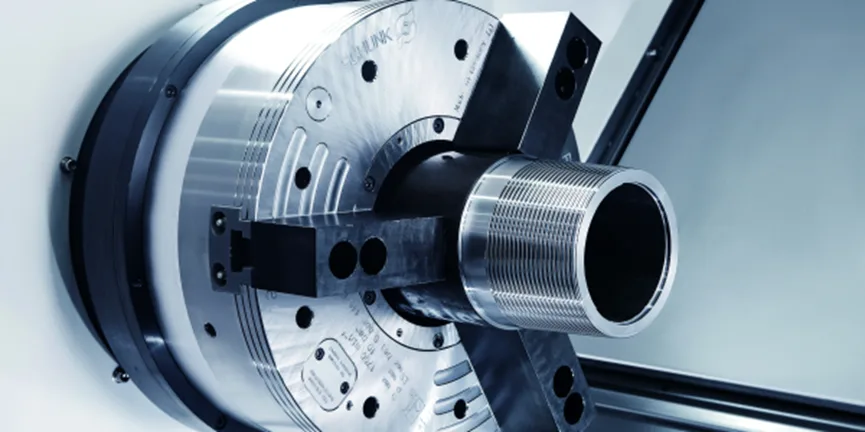
A Big Bore CNC Lathe is a CNC turning machine developed for large-diameter pipes, hollow shafts, sleeves, cylinders, and other tubular workpieces that exceed the through-hole capacity of a standard CNC lathe. Instead of focusing only on maximum turning diameter, this type of machine combines a large spindle passage, suitable chuck capacity, rigid bed, and programmable CNC machining. This is important because a pipe may fit within the machine’s swing diameter but still be too large to pass through its spindle. For manufacturers machining large tubular parts, selecting the correct bore size can simplify workpiece loading, reduce unnecessary overhang, and provide a more practical setup for turning pipe ends, internal diameters, grooves, threads, and connection surfaces.
Why Standard CNC Lathes Can Be Limited by Pipe Diameter
When choosing a CNC lathe, buyers often look first at swing over bed or maximum turning diameter.
For pipe machining, this is not enough.
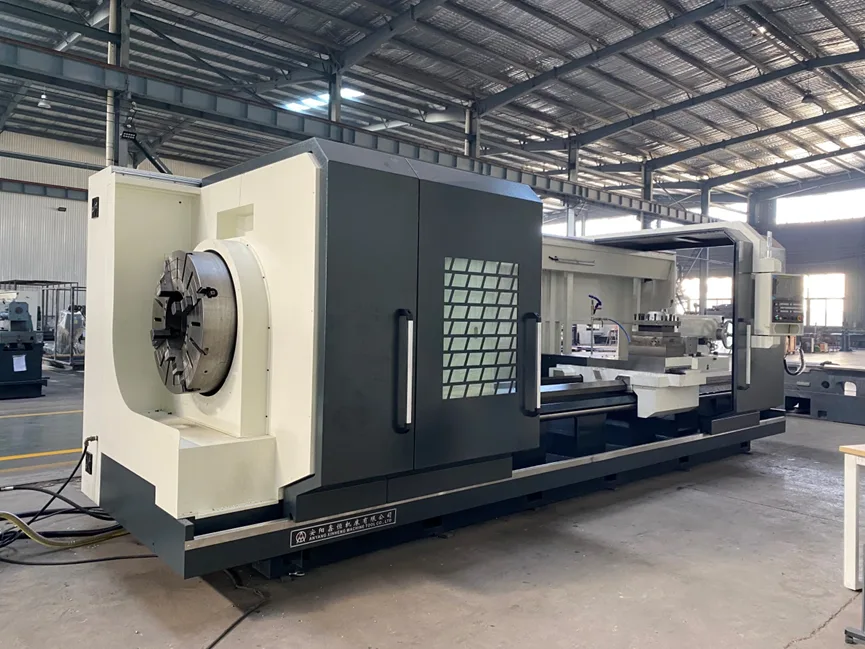
Consider a large hollow pipe that can physically rotate above the lathe bed. If its outside diameter is larger than the spindle passage, the pipe cannot pass through the headstock.
This creates an important distinction:
Turning capacity determines what can rotate on the machine, while spindle bore determines what can pass through the spindle.
For long-pipe production, both parameters must be checked.
Large Diameter Does Not Always Mean Heavy Workpiece
Another important consideration is pipe wall thickness.
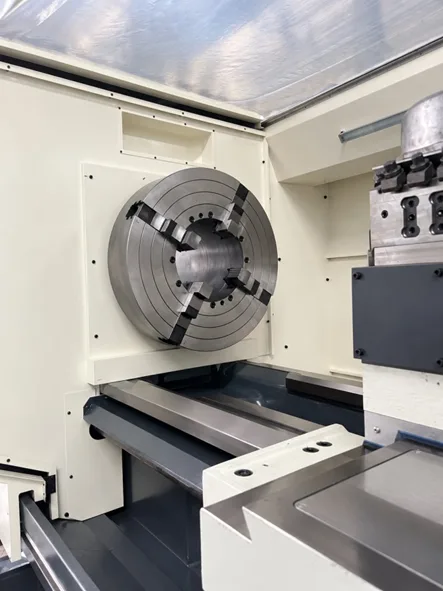
A large-diameter thin-wall tube behaves differently from a solid shaft. Excessive chucking force can distort the pipe, while insufficient force can cause movement during cutting.
For this reason, the machining setup should consider:
For long or relatively flexible pipes, suitable external supports can help control vibration and deflection.
CNC Advantages for Repetitive Pipe-End Machining
The advantage of CNC control becomes especially clear when multiple pipe ends require the same geometry.
Once the machining program and tooling are correctly established, the machine can repeatedly perform operations such as:
| Pipe Feature | CNC Operation |
| End face | Facing |
| Outside diameter | OD turning |
| Inside diameter | Boring |
| Connection shoulder | Step turning |
| Edge preparation | Chamfering |
| Seal groove | Grooving |
| Connection thread | Thread cutting |
This reduces dependence on manual adjustment between similar workpieces and makes a big bore CNC lathe suitable for batch production.
Choosing by Pipe OD and Wall Thickness
A practical machine selection should start from the actual workpiece rather than simply choosing the largest available spindle bore.
For example, two pipes may have the same outside diameter but require completely different machining conditions if one is a thin-wall tube and the other is a heavy-wall component.
Buyers should therefore provide:
Where Is a Big Bore CNC Lathe Used?
A big bore CNC lathe is not limited to oilfield pipes. It can also be used for large sleeves, hollow shafts, cylinders, rollers, pipeline components, mechanical tubes, and heavy equipment parts.
Typical users include pipe manufacturers, machinery factories, repair workshops, energy equipment manufacturers, and subcontract machining companies.
At Anyang Xinheng Machine Tool, different CNC lathe configurations can be selected according to workpiece diameter, length, material, and machining process.
For machine selection, send us your workpiece drawing or pipe dimensions, and we can evaluate the required spindle bore, turning capacity, clamping method, and CNC configuration.