

Short Answer
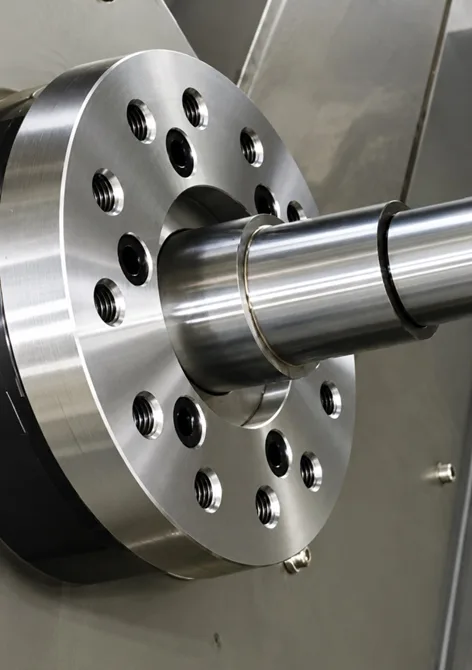
Spindle nose type refers to the standardized connection interface at the front end of a lathe spindle where the chuck, faceplate, collet chuck, or other workholding device is mounted.
Its design must ensure a secure, repeatable, and precise connection between the spindle and the tooling. There are various standard spindle nose configurations, such as threaded, cam-lock (D-type), or long taper with key (L-type), each suited to different types of operations and machine sizes. The spindle nose is a critical interface in turning operations, directly affecting the machine’s versatility and the rigidity of the setup.
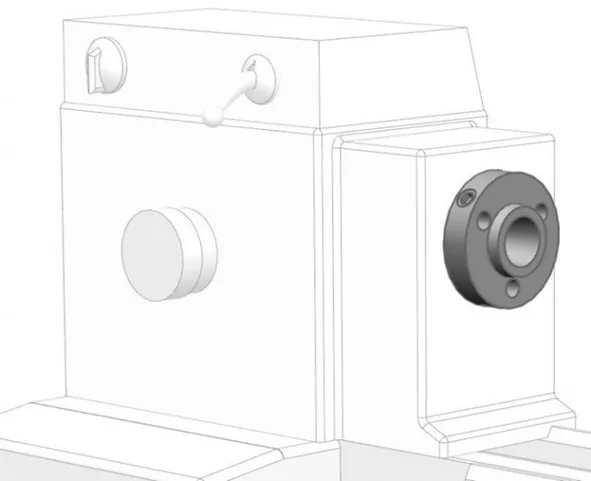
Common spindle nose designations on CNC lathes include A2-5, A2-6, A2-8, A2-11, and A2-15. The designation is important because the spindle nose must match the chuck or chuck adapter being installed.
Why Does Spindle Nose Type Matter?
The spindle transmits rotation and torque to the workpiece through the chuck or other workholding device. The spindle nose is the mechanical interface connecting these components.
Its type affects:
If a customer already owns chucks, faceplates, or special fixtures, checking the spindle nose type before purchasing a new lathe is especially important.
A chuck with the wrong mounting interface normally cannot be installed directly without an appropriate adapter or backing plate.
Difference Between Common Spindle Nose Types
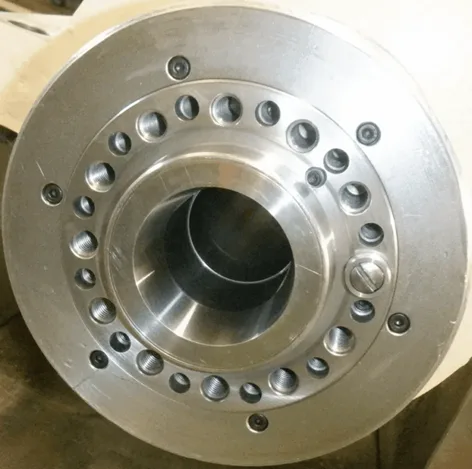
One common modern system is the A-type short-taper spindle nose, often written as A2.
| Example | General Application |
| A2-5 | Compact CNC lathes |
| A2-6 | Small/medium CNC lathes |
| A2-8 | Medium CNC lathes |
| A2-11 | Larger spindle/chuck applications |
| A2-15 | Large and heavy CNC lathes |
As the designation becomes larger, the spindle interface is generally intended for a larger mounting arrangement. However, A2-15 does not mean a 15-inch chuck, and the number should not be interpreted directly as chuck diameter.
Other machines may use different spindle nose structures, particularly specialized pipe-threading or heavy-duty lathes. Xinheng’s slant-bed CNC pipe-threading range, for example, lists configurations including A2-11, A2-15, short-cylinder, and threaded spindle nose types, depending on model.
Spindle Nose Type vs Spindle Bore
These two specifications are often confused.
Spindle Nose Type
Describes how the chuck or other workholding device connects to the front of the spindle.
Spindle Bore
Describes the diameter of the opening through the spindle.
They are completely different parameters.
For example, Xinheng’s 970 mm guideway CNC lathe series specifies:
Spindle Nose Type: A2-15
Spindle Bore: Φ130 mm
The A2-15 specification describes the mounting interface, while Φ130 mm describes the through-hole diameter.
Example
Consider Xinheng’s AE-series slant-bed CNC lathes.
The AE40B and AE45B use an A2-6 spindle nose with a Φ66 mm spindle bore. The larger AE50B uses an A2-8 spindle nose with a Φ86 mm spindle bore. Chuck sizes also increase from 8/10 inches on the smaller configurations to 12 inches on the AE50B.
For much larger workpieces, the spindle connection changes accordingly. Xinheng’s CK61125E, CK61140E, CK61160E, and CK61180E 970 mm guideway CNC lathes all specify an A2-15 spindle nose. These machines are designed for large shafts, rollers, cylinders, and other heavy industrial workpieces.
This illustrates why spindle nose type should be considered as part of the complete spindle and workholding configuration.
Common Mistakes
A common mistake is assuming that spindle nose type determines spindle bore. It does not. Always check both specifications separately.
Another mistake is selecting a chuck only by its diameter. Two chucks with the same nominal diameter may have different mounting interfaces.
Buyers also sometimes assume that a larger spindle nose automatically means better machining performance. In reality, the correct spindle nose should match the machine size, spindle design, chuck, workpiece, and cutting requirements.
Finally, do not confuse spindle nose type with spindle center taper. Xinheng lists these as separate parameters in its CNC lathe specifications.
Buyer Checklist
When checking the spindle configuration of a lathe, confirm:
For pipe and bar machining, spindle bore may be more important than spindle nose type, because the workpiece must physically pass through the spindle.
For large solid shafts or irregular components, chuck size, spindle nose, clamping method, and machine load capacity become more important.
FAQ
What does A2-6 spindle nose mean?
A2-6 identifies a standardized short-taper spindle nose configuration. It defines the spindle/chuck mounting interface; it does not mean the spindle bore is 6 inches.
Is spindle nose type the same as chuck size?
No. Chuck size describes the physical chuck diameter, while spindle nose type describes how the chuck or adapter connects to the spindle.
Can I install an A2-8 chuck on an A2-6 spindle?
Not directly as the mounting dimensions are different. Chuck compatibility and any required adapter should be confirmed with the machine and chuck manufacturers.
Is spindle nose type important when buying a CNC lathe?
Yes, particularly if you already have chucks, faceplates, collets, or special fixtures that you want to reuse.
What information should I send to the lathe manufacturer?
Provide the workpiece drawing, diameter, length, weight, material, required chuck type, clamping method, and any existing chuck or fixture information. For bar or pipe work, also specify the maximum diameter that must pass through the spindle.
Xinheng lists spindle nose type as a separate spindle specification across its CNC lathe ranges, so it should always be checked together with spindle bore, chuck size, spindle speed, and workpiece requirements.